Add font

Saturday, July 11, 2026

Shattered World Progress Update

Shattered World continues to lurch, crawl, mutate, and occasionally make alarming progress. The system’s core math is shifting. Universal Action Modifier is being replaced with Competence Modifier, which more closely mimics the 5e "Proficiency Bonus," (although different). Competence Modifier is more specific than the deprecated UAM. It applies when a character is acting through a Proficient Ability, a trained Skill, a Field Role Feature or Buy-In, or in certain Field Role cases such as Aegeides and Warriors making attacks, or Wizards casting spells, etc.

The big focus recently has been the Wizard Magic chapter, which remains one of the more intimidating pieces of the Alpha draft. That is not because the idea is weak. It is because the idea is strong enough to demand better rules than the ones currently holding it together with duct tape, spite, and inherited RPG ghosts.

Most Wizard magic is pulling double, triple, and quadruple duty. That's design as intended. I have deliberately removed spell levels from the game. Wizard recipes, mage spells, and Psionic powers will all be designed to grow with the character regardless of what spell or power you're using. That's design as intended.

The current direction is that Wizard spells are Recipes: prepared procedures using Bloodstones, physical materials, timing, handling, and risk. A good Wizard recipe should feel a little like occult chemistry, a little like lab work, and a little like something that should have required several permits and a liability waiver. It's mostly a flavor thing, but Wizard magic feels definitively different now—in a good way.

That approach is starting to show up more clearly in individual spells. Age, for example, currently feels much closer to what I originally meant by “Recipe.” It involves prepared materials, careful handling, Bloodstone logic, and a deeply unsafe result. Not every spell has been rewritten to that level yet, and I am not going to force that before Alpha, but that is the intended post-Alpha flavor for Wizard Magic.

A major cleanup pass also happened around Concentration, Duration, Elasticity, and lingering magical effects. The important realization is that these need to be separate rules concepts.

Concentration is about maintaining focus. For Wizards, that usually means the vulnerable period while casting. For Mages, it may also apply to maintaining some effects. For Psions, powers manifest instantly, but active manifestations require Concentration for their duration. Techno effects may vary depending on the device, Feature, or power source.

Duration is how long the active effect lasts.

Elasticity is the mechanic that allows Wizards to stretch, reform, lengthen, sculpt, or otherwise alter a spell at the moment of casting. It has a numeric limit based on the Wizard and the spell, and Nous is spent to push the spell within that limit.

Maintenance Nous, meanwhile, has been escorted out of the building. It was trying to solve a problem already handled better by Elasticity.

The bestiary conversion problem also raised its ugly little head. Shattered World allows Ability Scores to function as attack vectors, which means a creature with a low Mental Acuity score can potentially be attacked through that weakness instead of through HP and armor. That is intended to some extent. The game is supposed to reward attacking the weak point instead of always grinding through the largest number.

However, converted 5e monsters were not designed with the assumption that a low Intelligence score is also a tiny mental health bar. That means some monsters may need protection against [STAT] attacks. Oozes, undead, and constructs are likely candidates for broad immunity. Other creatures may need Stat Damage Reduction, Stat Damage Resistance, or more specific traits like resistance to Mental Acuity depletion. Vulnerability may exist eventually, but carefully. [STAT] attacks are already a dangerous vector.

There was also an important space weather breakthrough, because an RPGC user correctly observed that plasma storms instantly improve a fictional universe. So yes, plasma storms have been implemented. They may become part of the Void travel hazard system: charged particle fronts, Bloodstone interference, engine disruption, radiation, auroral whiteouts, psychic static, and the sort of environmental nonsense that makes space travel feel properly irresponsible. I'll be implementing space/shard weather in the future.

I'm still a little salty about not hitting my self imposed January 2026 deadline, but I'm also happy with the direction it's taking. In short, the Alpha is still a mess, but it is becoming a more specific mess.

Recent progress includes:

  • Replacing UAM with Competence Modifier.
  • Clarifying attack roll and proficiency logic.
  • Moving Concentration timing into Rapidly Evolving Situations.
  • Separating Concentration, Duration, Elasticity, and lingering results.
  • Removing Maintenance Nous as a likely dead mechanic.
  • Reworking Wizard spells toward Recipe logic.
  • Beginning the [STICKY] / Residual cleanup.
  • Identifying [STAT] attacks as a bestiary conversion issue.
  • Considering Stat Damage Reduction and Resistance.
  • Accepting plasma storms as obviously necessary.

The next major push is still Wizard Magic. It is intimidating, but the chapter finally has a clearer shape. The hard part now is not figuring out what it wants to be. The hard part is doing the work.

I swear I really am starting playtests soon, hopefully this summer. I just need to finish with the Wizard Magic chapter, and then do the Psionic and Mage magic chapters so they're alpha-ready.

As usual, preserved jokes where rules allowed.

Saturday, June 13, 2026

Game Balance Is Not the Same Thing as Sterility

Game balance matters.

Let’s get that out of the way first, because this is not an argument against balance. This is an argument against what the abused term game balance has increasingly come to mean in modern tabletop RPG culture.

In too many newer RPG conversations, “balance” has become code for sterility. Predictability. Homogeneity. A carefully padded room where no one is ever truly outmatched, no one is ever seriously in over their head, and no one ever has to say the most exciting sentence in adventure gaming:

“We need to run.”

That is not balance. That is predictability with buttons to push on character sheets.

And adventure is not supposed to be a safe choice.

What Balance Should Mean

At its best, game balance means that every player has a chance to meaningfully participate.

If one character is a walking fortress and the entire session becomes that character plowing through a hallway full of lizardmen while everyone else watches, that is not great gameplay. It may be fun for the megatank. It may be boring for everyone else.

That is a real balance problem.

But the solution is not necessarily to make every character equally good at hallway-plowing. The solution is twofold: a) design situations where different characters matter in different ways, and b) discourage uncreative, lazy, thoughtless gameplay. Force the players to find innovative ways to assert their characters.

Maybe the megatank holds the line while the engineer disables the gate mechanism. Maybe the wizard reads the battlefield and spots the ritual structure empowering the enemy. Maybe the operative finds the hidden route, steals the key, sabotages the alarm, or drags a wounded NPC out of danger. Maybe the party face talks a terrified prisoner into revealing the passage behind the shrine.

The goal is not for every character to do the same thing with different visual effects.

The goal is for every player to have a reason to lean forward.

That kind of balance is good. That kind of balance keeps a table alive.

What Balance Should Not Mean

Balance should not mean every character succeeds at roughly the same rate all the time, outputting roughly the same amount of damage.

Balance should not mean every combat encounter is calibrated so precisely that the players can assume the fight is “supposed” to be winnable.

Balance should not mean every locked door, social encounter, wilderness hazard, monster, trap, or magical disaster exists inside a narrow expected-success band.

And balance absolutely should not mean that every character is entitled to be in the spotlight at all times.

There is nothing wrong with your barbarian being bad at picking locks. There is nothing wrong with your pilot being unable to hack the system. There is nothing wrong with your psionicist having terrible etiquette. That is not a design flaw. That is texture.

Characters should have edges. They should have strengths. They should have weaknesses. They should sometimes look at a problem and say, “This is not my lane.”

That is one of the reasons we play party-based games in the first place.

The Pendulum Swung for a Reason

A little RPG cultural history is helpful here.

In the early days of roleplaying games, the balance of power often favored the Game Master heavily. That is understandable. RPGs were new. There were not many models for cooperative storytelling games. The hobby grew partly out of wargaming, and some of that competitive mentality came with it.

GM fiat was powerful, and sometimes it was abused.

That does not mean GM fiat is bad. I do not think tabletop RPGs can function without GM judgment. But it is fair to say that in the 1970s and 1980s, a lot of tables leaned hard into “because the GM said so.” In some cases, too hard.

Over time, the pendulum began to swing toward the players. By the late 1990s, and especially around the turn of the millennium, player agency had become a much stronger design concern. This was a good development. The hobby became less adversarial. More people recognized that the GM is not supposed to “beat” the players. There is only one possible outcome when a GM arm-wrestles the table: the GM wins, and the game suffers.

So rules became clearer. Player options expanded. GM authority was reined in. More games began emphasizing collaboration, player input, and shared investment in the world.

Again: good.

But pendulums do what pendulums do.

They keep swinging.

Familiar Footing, Flattened Worlds

Modern game companies want players to have a consistent experience. If someone buys a game, sits down at a convention, joins an online group, or plays an organized campaign, the publisher wants that experience to feel fair, welcoming, and familiar.

That impulse makes sense, to some degree, but also results in the most popular games being essentially on par with McDonalds.

But there is a cost when familiarity becomes sameness.

At a certain point, the game begins to feel like a franchise restaurant. Reliable, polished, predictable, and deadening. The meal is never terrible. It is also never surprising.

For me, that is poison to adventure gaming.

An adventure should not feel like a customer service experience. It should not feel like the players are moving through a padded attraction where everything has been pre-measured to produce a stable, acceptable outcome—and that's exactly what the most popular modern RPG's feel like to me. Adventure is dangerous. It should feel strange. It should sometimes feel unfair in the way the world is unfair, not because the GM is cheating, but because the world is larger than the characters.

Ever watch the 80s D&D cartoon? A first-level party encountering an ancient dragon goddess is not automatically bad encounter design. In fact, try that shit in your game today and you'll be burned at the stake.

It is bad encounter design only if the party is expected to fight her.

If the point is to trick her, avoid her, bargain with her, distract her, manipulate her enemies, steal something from under her nose, or get out alive with their eyebrows still attached, then that encounter may be fantastic.

The problem is not danger.

The problem is false expectations.

Encounter Math Is a Tool, Not a Law

Challenge ratings and encounter-building math were valuable additions to RPG design. They give GMs guidance. They help prevent accidental slaughter. They help designers think through pacing, attrition, and expected resource use.

Used properly, they are useful tools.

But tools become traps when the table starts treating them as promises, or even straitjackets.

If every fight is assumed to be level-appropriate, then the players are being trained to fight everything. If the numbers imply that most obstacles are calibrated to their current capabilities, then the players stop scouting, negotiating, retreating, planning, tricking, and fearing the unknown.

They begin to trust the math more than the world.

That is when the narrative loses something vital.

In some modern systems, the numbers can feel wound so tightly that every character, regardless of class, build, or concept, seems to operate inside the same narrow band of expected success and failure. Attacks, skill checks, saves, and tactical options start to blur together. The characters may look different, but under the hood they feel like the same engines wearing different skins.

That may be balanced in the spreadsheet sense.

It is not necessarily adventurous.

Failure Is Part of the Game

A tabletop RPG that never involves fleeing from a fight is not balanced.

A tabletop RPG that never involves failing at an important task is not balanced.

A tabletop RPG where the players can predict too cleanly when they are likely to succeed or fail is not balanced.

It is managed.

Failure is not an interruption of adventure. Failure is one of the engines of adventure.

The locked door you cannot open forces you to find another way in. The monster you cannot defeat becomes a recurring terror. The noble you fail to persuade becomes an enemy. The bridge you cannot repair changes the route. The spell that goes wrong creates consequences no one planned for.

That is the good stuff.

Not every failure needs to be catastrophic. Not every danger needs to be lethal. But if the game is designed so that meaningful failure rarely happens, or is softened so quickly that it barely matters, then the adventure starts to feel fake.

The world should push back.

The Spotlight Is Not a Permanent Residence

One of the strangest assumptions in some balance conversations is that every character should be equally relevant in every kind of scene.

I do not agree.

Every player should matter over the course of play. Every player should have chances to act, choose, speak, risk, and shine. But that does not mean every character should be equally useful in every moment.

Sometimes the warrior owns the scene.

Sometimes the scholar owns the scene.

Sometimes the pilot, thief, engineer, priest, wizard, diplomat, scout, or absolute disaster goblin owns the scene.

That is not imbalance. That is rhythm.

The key is making sure the spotlight moves.

If one character dominates every situation, something has gone wrong. But if one character dominates one specific kind of situation because that is what they were built to do, that is not a crisis. That is payoff.

Let the tank tank.

Just make sure there is more to the adventure than a hallway.

The Loudest Voices Are Not Always the Table

Another reason “balance” has become such a distorted concept is that online conversation rewards outrage.

A relatively small number of very loud people can create the illusion of consensus. They dislike a rule, declare it “imbalanced,” and then repeat that claim loudly enough that designers begin to wonder if the entire audience agrees.

Sometimes the criticism is valid.

Often (especially online) it is not.

Designers should listen to feedback, but they should not let the angriest voices redesign the game by intimidation. Some people are not trying to improve the work. They are trying to vent, dominate, or punish. No amount of revision will satisfy them, because they are not satisfiable.

If you are a designer, protect your mental health. Take useful criticism seriously. Ignore abuse. Block people when necessary. There is no virtue in letting strangers verbally grind you down in the name of “community feedback.”

A game cannot be designed by fear.

Why Not Just Homebrew It?

There is always someone who says, “Well, just change the rules.”

Of course.

Everyone knows the GM can change rules. That is not the point.

The real question is whether a game is worth homebrewing in the first place.

I will gladly modify a system I like at its core. I will tune it, expand it, cut parts away, replace subsystems, and make it my own if the foundation excites me.

But I am not going to rebuild a system whose basic philosophy bores me.

Why would I?

If the core experience feels sterile, over-managed, or hostile to the kind of adventure I want, then the issue is not one rule. It is the design center of gravity. At that point, I would rather play something else—or build something else.

Which, in a very real sense, is why Shattered World exists.

What Balance Means in Shattered World

Shattered World is not designed around the idea that every situation should be safe, fair, symmetrical, or level-appropriate.

It is designed around the idea that adventure is dangerous, characters are different, choices have consequences, and the world is not obligated to meet the party on even footing.

That does not mean the game is arbitrary. It does not mean the GM should be cruel. It does not mean the rules do not matter.

It means balance is not the same thing as sameness.

Balance means players have meaningful ways to engage.

Balance means different characters matter in different situations.

Balance means danger is telegraphed enough that smart players can make smart choices.

Balance means combat is only one possible response to threat.

Balance means running away is sometimes the correct answer.

Balance means the world is allowed to be bigger than you.

And most importantly, balance means the adventure still has teeth.

Because once the teeth are gone, what exactly are we adventuring for?

```

Friday, May 22, 2026

Just Gonna Drop This Here

It’s not that [the most popular, market-dominating] Nu RPG’s are too easy, it’s that they’re way too welcoming of lazy, uninvested, thoughtless gameplay.

Tuesday, March 31, 2026

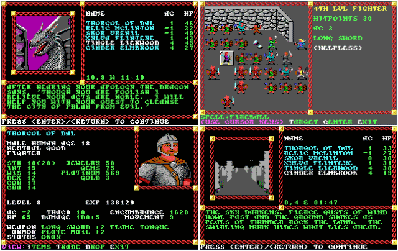
Diving Back into Phlan: A Look at SSI's Advanced Dungeons & Dragons: Pool of Radiance (1988)

For many, the name SSI conjures up a wave of nostalgia, and for good reason. In 1988, they unleashed Advanced Dungeons & Dragons: Pool of Radiance, a title that wasn't just a game; it was a digital gateway to the Forgotten Realms and a pioneering step in the evolution of computer role-playing games. The frequency of the camp animation in the game led my wife and daughter to affectionately (and perhaps a little teasingly) refer to it as the “camping” game whenever they see me playing.

While not the first AD&D video game, Pool of Radiance was the first to achieve a level of complexity that truly captured the feel of playing AD&D—earlier AD&D games, while commendable for their pioneering efforts within technological constraints, lacked the breadth and depth to fully replicate the tabletop experience. In that way, Pool of Radiance was the first of its kind.

As one of the inaugural entries in the revered "Gold Box" series, Pool of Radiance attempted to translate the intricate rules and lore of AD&D 1st Edition (note the incorrect but common internet myth: Gold Box games are not 2nd Edition AD&D) onto our nascent home computers. And while it succeeded in many ways, it wasn't without its share of goblin ambushes and, yes, some notable balance quirks. This game definitely has flaws—my suggestion is to love it for what it is and use workarounds to avoid the problems.

Groundbreaking Gameplay

Stepping into the ravaged city of Phlan, players were tasked with forming a party of up to six adventurers – rolling stats, creating visual icons, choosing classes and races straight from the Player's Handbook, and embarking on a quest to rid the land of a malevolent force.

Advanced Dungeons and Dragons is way Better Than Regular Dungeons and Dragons!

One of Pool of Radiance's greatest strengths was its adherence to the AD&D ruleset. Spell memorization, THAC0, Armor Class, saving throws – it was all there. For tabletop veterans, this was a dream come true, offering a faithful digital rendition of their beloved hobby. The tactical turn-based combat, played out on a grid, demanded strategic thinking and careful positioning. Successfully navigating a challenging encounter felt genuinely rewarding, a testament to the game's depth.

However, the Gold Box games, including Pool of Radiance, were not immune to balance issues. Some character classes, particularly early on, felt significantly weaker than others. Magic-users, for instance, often struggled in the initial hours with limited spell slots and fragile constitutions; most of what they would be doing in the slums is spamming Sleep spells, but not too long after that segment Sleep is all but useless. Certain enemy types could prove disproportionately challenging, leading to frustrating "save scumming" – a common practice for players navigating the game's unpredictable difficulty spikes.

Some (read: me) didn’t just psuedocheat—they cheated cheated. Presented with the choice of slagging through wildly unpredictable and imbalanced encounters, and losing lots of characters in the process, or circumventing at least enough of that to get through the game, I generally chose the latter. A few in-game options were to edit your character stats to the maximum possible (yes, please), create duplicate items by abusing the “remove from party” feature, and—oopsies—casting a stinking cloud that envelopes, but does not target, the hired lawful evil fighter with +1 plate mail, and then letting him die by the enemies’ hand so I can gain access to his inventory (this was suggested in a 1988 Dragon magazine). Nice. And for those of us who were more technically/programmatically minded, we could jump into a hex editor and edit the save game files to go beyond what the game design would allow. Careful, though, pushing it too far will break it.

The game's pacing certainly felt uneven. Periods of intense combat and exploration were often interspersed with lengthy stretches of travel and inventory management. While these elements contributed to the overall feeling of a grand adventure, they could sometimes bog down the momentum.

Spectacular EGA (That Means 16 Colors, Kids) Graphics

The game's presentation was groundbreaking for its time—remember that before this was “CGA,” 4 colors (black and white, puke pink and toxic waste cyan). While visually simple by today's standards, the overhead exploration map and the first-person perspective during combat were immersive and brought the tabletop experience to life. The detailed character portraits and the descriptive text accompanying encounters painted a vivid picture in the player's imagination. The screen design and presentation of gameplay were thoughtful, innovative, effective, and visually attractive.

Saturday, February 21, 2026

Safe Tables, Dangerous Villains

Villains are one of the foundational elements of a heroic story. They are just as required for your heroic RPG as pistons are required for your car’s engine. It’s 6:44am as I write this, which as every creative type knows is when the most insightful, inconvenient truths strike.

In the modern RPG world, consent and accessibility is an important, if not hot, topic. Before you either A) click away or B) start foaming at the mouth, I might not be about to say what you think I’m about to say. We all want our tables to be welcoming and inclusive, and that’s a good thing.

If you do want that, the temptation to make every little thing in your safe and accessible in your campaign is real, and understandable to a degree. But if you look at this practice honestly, you will see it comes with a cost.

Your villain must have teeth.

In a hero’s journey, the villains have to be villains. File down every other sharp unsafe edge in your game that you want. Make the traps throw inflated balloons and confetti at the PC's. Make it snow cotton candy in what should be a harsh environment. Blissfully assume all food, water, and shelter needs are always met at all times with no snags or cares. Remove disease from your world. Remove every unpleasant thing you want.

But your villain must have teeth. You cannot do what you're trying to do without villainous villains. And that's not pleasant or fun. It's not supposed to be. It's supposed to be motivating. Nothing in the fantasy/sci fi/grimdark genre works without this element. Antagonists antagonize.

The Mechanics of Heroism

If the villain is not dangerous, a hero is not necessary. HEROES don’t go around fighting everyone they see that they deem to be bad guys because they look the part, nor do they go breaking into temples and ruins looking to extract all the loot because it sounds like a fun Sunday afternoon activity. Assuming we're looking for RPG heroics, as much fun as it is to gallavant about town crushing walnuts with your buttcheeks and slicing the heads off orc babies to play soccer─and make no mistake, I could do this for hours─but without a legitimate threat, it's ultimately pointless and in fact masturbatory.

In fact, this is about where that fine line between villain and hero lives. Put that idea in your pocket.

Not all RPG's are hero-driven, but they are more the exception than the rule. But I might be spared one or two tedious "ayckshually" comments if I bring them up: Call of Cthulhu, Cyberpunk, Mork Borg, Blades in the Dark, Vampire: The Masquerade, Paranoia, Delta Green. These games aren’t traditionally hero-driven per Joseph Campbell. But these counter-examples also aren't the "gotcha" you think they are. In those games, reality itself is the grim villain and it again cannot be sanitized. These systems provide no possibility, even remote or farfetched possibilities, of the heroes saving the day. All things will come to ruin, whether by the sword, by monsters, by insanity, or by the simple decay of time.

Yes, there are still more exceptions. MLP comes to mind. I play it with my daughter and her friends. Except, oh wait, that’s not an exception. The villains are in fact villains in MLP.

Maintain Accessibility by Weaponizing the Imagination

The tension between villains providing the necessary engine part for your game that they’re supposed to and being a yes GM that provides a safe experience for the players is real, but doable. And I mean without kowtowing or neutering your villain.

The key is to weaponize the players’ imagination. This is a game of imagination. What you leave implied is very often scarier than what is stated explicitly.

To give the villain teeth, here are some reasonably accessible villainous deeds they can perform: Steal something─the villain doesn't just want to rule the world and destroy the PC's, s/he wants to make it personal and take a family heirloom. Moral dilemmas force the PC's to make a choice─both choices can be a small victory for the villain regardless. For example, choose between putting out the fire he started to save the village from burning or pursuing and hopefully catching the escaping villain. A scar or permanent mark left on the world that will remain once the villain is (presumably) gone.

Those aren't bad, but ratcheting up the tension requires some chutzpah. That's just how it goes. Sorry. One big thing that can happen is a villain can villainize (is that a word?) across campaigns. Maybe the PC’s didn’t defeat the villain in the first campaign, maybe the victory is pyrrhic. Or maybe the PC’s were themselves defeated.

But the villain’s villainous villainy could also be more despicable. I am not gonna repeat every truly evil thing a villain could do, I'm going to leave it largely implied. If you don't want to be explicit, you can leave it implied and "fade to black," but excluding it altogether actually neuters your villain, making them less effective and therefore watering down the excitement of your adventure. The relationship is direct. Sorry. It's not pleasant to hear, but it's the truth. That's how this works.

There is of course a huge difference between celebrating behavior and utilizing it as a narrative engine. While these behaviors should be off the table for heroes, and can remain implied for villains, they should not be scrubbed and sanitized from a hero campaign, because this is basically a list of why heroes are necessary. It's basically just as simple as that.

Watch Firewall with Harrison Ford and note the narrative effect of a neutered villain. The film basically fails because at several major story beats the villains are putting on a show of, "well, you and your family are really gonna get it now!" and then they back down almost immediately. They’re full of piss and vinegar but do not actually bite. This is how your game fails.

Now compare a film like that to 13 Assassins (if you can stomach it). This villain is a man who is ready to recklessly start a war and is fully unconcerned with who he hurts or kills in the process. What's great about the impact of this film, other than what I've already mentioned above, is how at the very end the villain is so strongly humanized and shown as a vulnerable, possibly even sympathetic being in a way. I'm not suggesting that excuses what he did throughout the film of course, I'm suggesting that it adds dimension and texture. And in this particular case the way it's set up is very unexpected.

The key is to frame all this as the mechanics of villainy rather than real world commentary. In a game, these aren't "topics for debate," they are crimes committed by a force that must be stopped by the heroes. This again is WHY they are heroes, and WHY heroes are needed.

I promise I'm not part of the "Fuck your feelings" crowd, who so often miss the irony of what they themselves are saying. That's not me at all. I'm not ignoring your consent comments or advocating that anybody else does. A good GM should be able to role-play a villainous villain within a few safety parameters if necessary. And a good GM should be equipped to balance that out and give their villains teeth.

Tuesday, February 10, 2026

New Home, New Horizons: Shattered World Update

Hey check us out! We’re shatteredworld.com now! Yay us! The old site, thorinteague.com is gone. Please update your bookmarks and head straight to the new domain from now on.

I don’t do enough updating, let’s face facts. It’s the heartbreaker reality. It’s just that, when I’ve got spare time to sit down and write one of these updates, I would really rather be spending that time on the project itself. It is a passion project in my spare time, after all. You know, like all of us folks writing these fantasy heartbreakers. Every leisure hour spent on a blog post is an hour not spent on the actual project!

Anyhoozoo, December 31, 2025 came and went with no fanfare or drama, and I missed my self-imposed deadline for a full alpha. Which doesn’t bother me a great deal, but kind of a bummer. Nonetheless, progress continues. I’ve printed the whole book out and I’m red-penning the whole thing now. So the work right now is analogue. It’s a different mindset and it’s a good idea to do once in a while to change perspectives. I recommend the same for your project. Periodically print it out and do some analogue editing. Other aspects of the text often jump out to me in comparison to digital.

When I get to the end, I will go back to the digital files and make the edits I’ve written out, and at that point I’m probably calling it Alpha. I’m not going to set another artificial deadline that doesn’t get met, but I will just say it’s coming. Soon.

There isn’t really much else to say. I have been editing. Nothing end users can see, but it’s coming.

Friday, January 2, 2026

NO ALPHA FOR 2025

I didn't hit my goal of having a good Alpha version for 2025, but I feel good about the state the game is in now and I am confident that it's shaping up well. I could probably have another playtest anytime, but I had the idea that I wanted it to be a basically complete Alpha before playtesting again. Nonetheless, playtests could probably resume anytime.

I am still pretty satisfied with where I'm at in spite of technically not hitting the goal I set. I did print it out to edit on paper, which helps me look at it differently than on the screen. Here's what it looks like printed out:

The state of the game has evolved from a wildly swingy (too swingy) system that I was basically inventing from the ground up into a still swingy but toned down hack of a basic public domain RPG system. My goals for the system remain the same: make adventuring dangerous, reward play styles other than just combat (there are combat rewards as well), create a bespoke system to facilitate Syseria/Shattered World, and create a fine detail level of design control over the player's characters. And in those aspects, I believe the system to already be a success.

Tuesday, April 29, 2025

The Continued Progress Continuing to Progressively Continue... Yep.

Hey everyone, just popping in with a quick development update from the trenches of pre-alpha!

Right now, my head's deep in the weeds of the combat and adventuring time movement chapter. It's a wild ride, let me tell you. One minute I'm feeling like I've struck gold, that the mechanics are clicking and the gameplay is going to be awesome. The next, a wave of doubt crashes over me, and I'm convinced it's all just… not good enough.

The pre-alpha development cycle is a constant exercise in self-trust (and a healthy dose of second-guessing!). It feels like I have to recommit to my design decisions almost daily, reminding myself why I chose a particular path and sticking to my guns, even when the urge to completely overhaul everything is strong.

But you know what? Truthier words were never spoken. Despite the internal rollercoaster, I'm actually pretty happy with where the combat chapter is sitting right now, at least for this early stage. It feels like it's got some teeth and offers the kind of dynamic encounters I'm aiming for.

Adventuring, on the other hand… well, that's a different beast entirely. Right now, that chapter is mostly just a big ol' placeholder – the 5.1 SRD slapped in there as a temporary measure. It's definitely not the long-term solution and will be getting a serious overhaul as I nail down the unique adventuring and exploration mechanics for the game. That's a journey still very much in progress!

If you're curious to see this chaotic (but hopefully promising!) pre-alpha in action, we're running another playtest this Friday night. We'd absolutely love for you to join us and get a firsthand look at the current state of things – warts and all! Your feedback at this stage is invaluable in shaping the game.

More details on how to join the playtest will follow shortly. Stay tuned, and thanks for following along on this crazy, progressive, and continually progressing journey!

Saturday, April 26, 2025

Progress Continues to Progress

Hello.

It's been an incredible journey building the Shattered World. Progress continues on this passion project, and your input is appreciated. We are starting to dip into playtesting here and there, and that will continue. The journey is an emotional ride, that bounces between excitement, and feeling that the game isn’t good, or at least isn’t right. Among other gooey stuff.

Shattered World Discord Channel

This channel was envisioned as a central hub to connect with all of you with two primary purposes. One was to explore the vast possibilities of our world together. The other idea was to play other games, including bringing on other talented Game Masters to run games within the Discord. Life, as it often does, had other plans. However, the spirit of community and shared adventure remains strong, and the channel continues to be a fantastic place to discuss lore, brainstorm ideas, and connect with fellow enthusiasts. We've also dipped our toes into trying out some different game systems within the Discord, which has been a blast and opened up some fascinating new perspectives! I still welcome other Game Masters to run games on the Shattered World server.

Oh and by the way, GOOD NEWS! By which I mean BAD news! I read recently that Discord is gearing up to go public, which most likely means bring on the enshittification. It will probably be a slow process, but I'll be keeping an eye out for alternatives to take my group to, if it comes to that. Just something to be aware of. I'll give plenty of heads up that the time has come to jump if the ship seems to be catching fire.

Shattered World TTRPG Design Progress

This has been an incredibly rewarding and, yes, deeply passionate experience! There's nothing quite like the thrill of bringing a new game to life, and I've poured my heart into crafting a system that truly breaks the mold.

My vision has always been to create a granular design that empowers the players to forge truly unique characters. Imagine tearing down those traditional class barriers and building heroes with unexpected and potent combinations of abilities—that's the magic I'm striving for!

The invaluable feedback we've received through playtesting has been illuminating. It's clear that while the depth of possibility is exciting, we need to make the entry point a bit smoother. Think of it as carefully calibrating the complexity to ensure everyone can jump in and start crafting their dream characters. Guided character creation is definitely on the horizon to make this process even more intuitive and enjoyable.

I have a wonderfully extensive skill list... a bit too extensive. Currently boasting a fantastic array of nearly two hundred options! While I recognize that some streamlining will enhance the overall experience, I remain steadfast in my core philosophy: reimagining access points and making a wider range of abilities available to a broader spectrum of characters. This is what makes Shattered World truly unique, and it's a design principle I'm deeply committed to. But uhhh, yeah... skills are getting pared down some. 😁

Plan B

If I decide this core design philosophy is untenable, and that's a big if, then plan B is to push the dial in the direction of For Gold & Glory. In fact, I'm already going there in bits and pieces. 

Looking ahead, I'm also keeping an open mind and exploring different avenues to bring the best possible game to you. This includes drawing inspiration from other fantastic systems, like Traveller. In fact, you might already see some subtle Traveller and FG&G influence subtly weaving its way into the Shattered World design as we continue to evolve!

Ultimately, the journey of creating the Shattered World TTRPG is a collaborative one, and your enthusiasm and feedback are invaluable. We're building something truly special here—a world where your imagination is the only limit. Stay tuned for more updates, and thank you for being a part of the adventure!

Tuesday, April 22, 2025

Great Playtest!

I've been posting the same recruitment message for a few weeks now and have been met with silence.... then yesterday I got a flood of responses. When it rains it pours! That was a good playtest session!

Saturday, April 19, 2025

Progress Continues!

I'm going back and forth between building excitement and feeling like the game design isn't good enough. Right now I feel like my excitement is really starting to build. 

Wednesday, April 16, 2025

Shattered World Guide

The Shattered World Guide has been updated to include current work as of 4/16/2025. I couldn't get it to embed very well, so for now I just copied and pasted the text. Meaning that further updates past 4/16 will not appear until I can get the documents to embed properly.

It is, however, a lot more up to date than what was there previously, and reflects all of the work on the fantasy heartbreaker up to this point.

Thursday, April 10, 2025

Just sayin' hi

HEY EVERYONE!

DOES ALL OF LIFE FEEL FUTILE?

IS EXISTENTIAL DREAD PARALYZING YOUR ABILITY TO FUNCTION AND COPE IN THE REAL WORLD?

IS YOUR SOUL SCREAMING OUT TO AN INDIFFERENT UNCARING UNIVERSE? AN INFINITE BLACK VOID OF NOTHINGNESS THAT DOESN'T CARE OR EVEN HAVE ANY AWARENESS OF YOUR EXISTENCE?

........................... I'm sorry, I forgot where I was going with this.

How are you doing?

Saturday, April 5, 2025

SHATTERED WORLD: Continuing to climb the mountain—Skills is getting close to alpha-ready. (54 pages)

Feedback Request

https://docs.google.com/document/d/e/2PACX-1vSX74P7qDuPh_-HOuM1xxrOZvIJNINbOyb14nE9Nbp-EMU0TA5lu1RRllOjg9jDK4CPXuS78U8NMJpl/pub

After two years of iterative design on my SciFantasy Heartbreaker TTRPG, built within a bespoke setting, the skills chapter has reached a robust 54 pages and is approaching an alpha version. My core design philosophy centers on deep player agency through a highly granular, component-based skill system. This empowers players with finite control over character abilities and design, fostering emergent gameplay and meaningful specialization, effectively shifting emphasis from rigid classes towards a truly player-driven character paradigm.

I'm now looking for your sharpest critiques and most insightful suggestions on this chapter. Does the level of granularity seem to offer meaningful choices, or is it overwhelming? Are there any obvious gaps in the skill list, or places where things feel redundant? Lay it on me – constructive criticism, brilliant ideas, even just your initial gut reactions are incredibly valuable. Take a look, tell me what you think, and help me make this skill system truly shine for players!". Really anything you want to throw at me is valuable and I appreciate you taking the time to read and comment. Just don't insult my wife. She didn't do anything to you.

This is a spare-time passion project of one guy with no budget. I am not a business, I am not a publisher but I AM familiar with the pro design & media industry and have worked in the private sector in non-gaming contexts, I'm barely a professional game designer (I wrote a few things that now sit languishing in production hell--you know the story). This is probably to be expected around these parts, but I figured I'd say it.

This project started as a D&D setting, and after a certain historical event occurring on Friday the 13th, 2023, the thirteenthiest Friday the thirteenth that ever Friday the thirteenthed, I started on a fantasy heartbreaker tailored to Syseria. I retconned a planet shattering (previously it was the continents getting reshuffled) and reworked a few (though not many) aspects of the lore. The Shattered World, I now realize, subconsciously presented itself as a metaphor for the game setting and design of the TTRPG. The iterative process of decades has left many design artifacts from previous editions that are still being removed and reworked. This work will continue all year, and probably beyond.


If you're looking for broader context, here are some of the other sections of the work. It's a challenge because even asking a community to look at a 54 page document is a big ask (and I'm certainly not expecting anyone to literally read it start to finish, in its entirety), and this whole thing is bordering on 600 pages. (According to google docs). I do not expect ANYONE to actually read all this. This makes the lack of context a real pickle for posts asking for feedback. I don't generally dump the whole thing because there's a lot, but I'll try to give the best TLDR I can.

Core Engine (12 pages)

https://docs.google.com/document/d/e/2PACX-1vSEbqwarKfDC0zwkTorbeoYMeoV0_amqlIQjE0L2xJC3ySUEqSEr_lLI-9Gk0eXBwOyDPcFHfHU-Yw7/pub

TLDR: The granular Skills system will interact with this escalating roll-over mechanic, and success will determine the effectiveness of the skill use based on the degree of success. The "Buy-In" system shows the first part of how players will invest XP (used as currency) to improve their class and character features (potentially higher rolls for skill-related actions or specific skill "bumps"). You earn points for doing stuff and spend 'em to git gud.

Lore (75 pages)

https://docs.google.com/document/d/e/2PACX-1vRwGkllFpuusPi3QUNsbOo6PDK5qu8MC9APJP--7yEI2bTwhbVEvoC37RUTqJ3NHRy12NIEzjnBITxA/pub

TLDR: I'm hesitant about providing a TLDR on this one, but here goes nothing.

The entity known as Xi, self-proclaimed architect of existence, grew weary of divine squabbles spilling onto crafted worlds. Thus, Syseria was conceived: a final, ambitious endeavor intended as a sanctuary, yet marred by the intrusion of 'Bloodstone' – raw threads of cosmic forces, each bound to fundamental aspects of existence – Time, Chaos, Magic, the Sun's fierce nova, the all-consuming Void, the ephemeral nature of Thought, the unsettling Weird, the essence of Soul, and the driving force of Volution. These 'Bloodstone Aspects' are not merely domains; they are the very fabric to which these powers are tethered, their influence radiating through the cosmos in tangible ways.. These potent fragments, discovered by the ill-fated King of Evil and manipulated by the Deceiver, Kynteelas, have rendered Syseria a locus of unpredictable energies and lingering chaos from a prior 'Dark Times' ignited by fractured interdimensional portals. Xi, in a moment of divine candor, admits to a singular failure: the intended perfection of Syseria remains unrealized, forever tainted by the allure and peril of Bloodstone.

Before the reckoning of mortal time, the divine entity Xi wearied of its progeny's cosmic bickering and conceived Syseria as a potential balm. This nascent world, imbued with foundational energies, was set apart by divine decree, shielded from direct godly intervention. Yet, prior to its formal genesis, a spacefaring race known as the Devas arose – entities of immense psionic power who embarked on a 'Great Journey,' seeding the cosmos with their creations: the steadfast dwarves, the long-lived elves, and the more volatile humans, among others. Their endeavors, fueled by a hubris that bordered on the divine, ultimately drew the ire of the true gods, setting the stage for a cosmic drama that would irrevocably shape the destiny of the yet-to-be-discovered Syseria.

The shattered fragments of Syseria, a world rent asunder by celestial conflict, nonetheless present a paradox of accessibility, facilitated by arcane portals and the resurrected technologies of a lost age. Across its jagged continents – the war-torn kingdoms of Cirisca, the undead-haunted Blackened Wood, the subterranean dominion of the Dwarven Empire – disparate societies carve out their existences. Remnants of the advanced Devas linger as enigmatic ruins in Magia Nolan, while the sprawling archipelagoes, from the tropical Isla Notau Nai to the volcanic Dragon's Maw, teem with a chaotic biodiversity. The arid expanse of Temek harbors both splendor and savagery, contrasting with the tradition-steeped deserts of Al Quraya Kahn and the (currently redacted) mysteries of Shin-Xiao. Dvoria stands as a militaristic dictatorship amidst ancient ruins, while Karamunduria remains an apocalyptic wasteland plagued by banditry. The frozen north, Sorvestedsstäd, a land of giants and cyclical volcanic fury, stands apart. Connecting these disparate realms are the Portal Cities – metropoli acting as nodes in an instantaneous transit network, each with its own distinct character and economy. In essence, Syseria is a fractured yet interconnected world, its diverse landscapes and inhabitants bearing the scars of a cataclysmic past while simultaneously striving to rebuild and rediscover the secrets of ages long gone.

Syseria is a mashup world reaching across multiple genres. I am doing my best to embrace and emphasize the mashup nature of the world.

Character Inception (37 pages)

https://docs.google.com/document/d/e/2PACX-1vSZtMVGlRn1Z7sTyG4K1Dt6KN-uwyK_eCe1kasl4cF4tKttgI5PgzcImXnG4-dvYnivLgdFxQt-QlTq/pub

TLDR: The genesis of a persona within Shattered World involves a measured allocation of fundamental aptitudes – physical, mental, spiritual – across a spectrum of available hominid (and other) species. One then designates a primary vocational inclination, a 'Field Role,' which serves as a template and initial vector for the acquisition of competence. This design process is in essence the instantiation of a nascent protagonist poised to navigate a fractured reality. It's all about building the character you want to play from the ground up.

Main Species (31 pages)

https://docs.google.com/document/d/e/2PACX-1vTchLzBMFT3OK5qeUA1OMrOfQnn4M4yYaZmKlEcnV9n5epJDX1EIF89dB7ZJa2PesLWv08z-Y_0Ttvy/pub

Within the fragmented cosmography of Shattered World, the sentient substrates available for inhabitation extend beyond the predictable taxonomies. One confronts a panoply of Volk – dwarves, forged in subterranean strata with a tenacity echoing the very bedrock; elves, whose attenuated lifespans and inherent affinities whisper of ages long past, a lineage tracing back to epochs predating the Sundering. Humankind, ever adaptable and prone to both profound ingenuity and regrettable folly, remains a ubiquitous, if somewhat stochastic, element. And then there are the differently-wrought – goblins, orcs, and others whose origins lie shrouded in the mists of the Dark Times, each bearing the indelible mark of that cataclysm. The selection of one's Kindred is not merely a cosmetic choice; it dictates inherent predispositions, cultural inclinations, and a foundational narrative thread woven into the very fabric of this fractured reality. Choose wisely, for such choices bear consequences that ripple through the unfolding saga.

Uncommon Species (94 pages)

https://docs.google.com/document/d/e/2PACX-1vRaTryX1r-OepLjx093OB6NTfPoY7WH0IGOk-f4WvyvS0LeSFzOq5rynS0swfVmaEirREQ3iaMZGRth/pub

Beyond the more frequently encountered Ethnoi of Shattered World lie lineages touched by the strange currents of its fractured existence. Consider the Autons, beings of enigmatic manufacture, their very sentience a question whispered in the shadowed corners of technological arcana – a stark reminder of a lost, perhaps hubristic, age. Then there are the Quicklings, whose rapid temporal perception renders them almost ephemeral to the slower senses, their existence a fleeting dance on the edges of conventional spacetime, bearing echoes of realms beyond mortal kin. And one must not forget the Crossbreeds and Hybrids, beings born of unorthodox unions, their very forms testaments to the breaking of natural order, often bearing both the boons and the burdens of their mingled heritages – a living embodiment of the world's inherent instability. To choose such a path is to embrace the exceptional, to court the gaze of the curious and the wary alike, and to embark upon a narrative trajectory decidedly less traveled, fraught with both unique peril and singular potential.

Field Roles (108 pages)

https://docs.google.com/document/d/e/2PACX-1vQTnJ3-h7JzaByHj4tgOeVVxyQWVl0U9f3dd5BKYCyPo0kvWkr90DMtMMbUsyuJmg1dIysmvN_Mn4Uv/pub

The societal architecture of Shattered World necessitates a division of labor, codified into 'Field Roles' – archetypal vocations that delineate a character's primary sphere of competence. To select a Field Role – be it the martial adept (' Warrior or Elite Warrior'), the psychic manipulator ('Psion, Wizard, Mage'), the shadow-draped operative ('Rogue'), or the artificer of technological marvels ('Engineer') – is to define one's initial skillset and trajectory of expertise. These roles are not mere class labels; they represent fundamental orientations towards interacting with the world and its myriad challenges, providing a structured framework for the development of specialized proficiencies and the acquisition of consequential abilities. Choose your path, for it shall shape the contours of your efficacy within this fractured reality. The character system in Shattered World tackles two main design challenges: reimagining the traditional character class, and empowering players with significant agency in crafting their heroes. This is [hopefully] achieved by reimagining deconstructing common RPG classes, species, and other elements into their fundamental components. This component-based approach, alongside a reimagined class structure, empowers players to realize their unique visions in a unique, reimagined design space.

(I'd like to take this opportunity to remind you all that this is the TLDR.)

The Syserian Pantheon (111 pages)

https://docs.google.com/document/d/e/2PACX-1vRQYXsmVB6FGlZkddYphBh8xjVBRJFop363j2RmTRa3XO8r-WDg_NRy2TYkqRs3qR9kDuvlKi8VD4CW/pub

TLDR: Within the fractured reality of Syseria, divinity is not a monolithic certainty but a fractured landscape of potent entities. Some are ancient architects of creation, others perhaps emergent phenomena of the universe's turbulent history. Their interactions are not always benevolent, their agendas often inscrutable to mortal minds, and their power, while immense, is not without limitations, particularly within the peculiar confines of Syseria. Mortals, in turn, often find themselves unwittingly bound to these aspects, their destinies subtly (or not so subtly) shaped by the divine currents that flow through the Land of Bloodstone. Beware those who claim to speak for these powers, for the truth of their intentions may be as shifting as the sands of Temek or as absolute as a decree from a God.

Equipment (29 pages)

https://docs.google.com/document/d/e/2PACX-1vShWXJmtLOBAd0VmtNWvpXRCRIS34OmgvjzZmftYsvzkpxKCSbcDw0EtXMUS-Dlv6uXB4Wx47ltAFhi/pub

TLDR: Gear Up in Shattered World! Adventurers in Syseria rely on four main coins: the common Solaureus, the less frequent Cyan's Tear (platinum), the rare platinum trade bar, and the base Wishcaster. Starting funds vary by your background. A Solaureus buys basic necessities. Wealth is often tracked in Solaurei, with larger transactions using platinum or trade goods. Equipment includes weapons (categorized by size and damage type), armor (with varying protection and hit points), tools, and unique SciFantasy tech like Engine-powered devices (Jetpacks, Freeze Rays, Reimagined Armor or power suits, etc.). Magic items include Runes for enhancements and Kyanite/Isis crystals for remote communication. Be mindful of encumbrance and the distinction between common and old-world currency.

Adventuring, Time, Movement, and Combat (23 pages)

Adventuring, Time, Movement, Combat

TLDR: Movement speed is defined. Exploration uses abstract scales by design, with the intention of scalability. Time is tracked in days, hours, and abstract combat rounds. Vision is impacted by light levels; darkvision exists. Modern assumptions about RPG units work perfectly (e.g. "Unit" = 5 feet in universe, "Round" = 6 seconds in universe, etc.) Encumbrance is slot-based. Fatigue is a stacking condition with escalating penalties. These rules govern movement, timekeeping, vision, carrying capacity, and exhaustion.

Magic (30 pages)

TLDR: Magic in Shattered World

Magic

"Magic comes from Bloodstones, once deadly, now (relatively) safe with a future expiration date. Spells are recipes using Bloodstone aspects, targeting stats or bodies. Everything's reversible. 'Elasticity' lets you tweak range, duration, shape, and tension on the fly. Wizards write recipes, others learn them differently. Grab a Magic Bloodstone and get casting!"

Document Info/TOC/Appendices/Glossary/History (20 pages)

Docinfo

(No TLDR provided)

Saturday, March 8, 2025

Shattered World TTRPG March 2025 Progress Report

Back from the Dead?

Hey everyone, quick update from the trenches of Syseria! Yes, Shattered World, my fantasy heartbreaker TTRPG, is still kicking and evolving. Remember when it started as just a setting for that other game? Well, it's grown up and decided to forge its own path! Let me see if I can be a little bit more explicit this time. I printed out the entire book and redlined a bunch of stuff.

The book was nice and thick all printed out, I was very proud of it. There was a lot of editing going on. I went wild with the red pen. Think battlefield surgeon, but for game design. Pages were marked, scribbled on, and updated, and reimagined. This round of changes have been made digitally, all that paper has been recycled, and I am probably going to do a few more rounds of this. What I'm wanting to do is eventually put the information into this website, because the information on Syseria is woefully out of date, but I would like the information to be more complete by that time.

I'm reformatting all species and field roles to encapsulate the new fantasy heartbreaker system that I am writing now. I'm still working on skills as well. There have been quite a few changes in what is under trainable skills and what is a field role feature, and that will continue to evolve. I knew I wanted one of the things I wanted out of this was a more granular skill system. And that has pretty much been achieved, at least skeletally.

Core Engine

I think the core engine has pretty much gelled into what I want to playtest. This is an escalating roll-over system starting at d4 with the possibility of going as high as d100. This creates a much wider spectrum of possibilities for your heroes, with foes like dragons and titans being about as far away from approachable as west is to east, and later, goblins and chumplings far away in the rearview mirror. From the beginning I wanted something that retains the fun of TTRPG combat in a style that I like while also providing an equally fun and rewarding system for non combat roleplay, including but not limited to social, downtime, professional, and exploratory activities. I don’t yet know what to expect of its viability out of the gates, but I’ve accomplished a sketch of what I set out for. All these documents including the core engine are and will remain for the foreseeable future a work in progress, living, breathing, changing documents. They will be informed by feedback and playtesting, soon.

Ability Scores

Your six ability scores will be Physical Fitness (PF), Mental Acuity (MA), Endurance (EN), Perception (PE), Empathy (EM), and Spirit (SP). Character inception is a two phase process: a gamble of circumstance followed by a design and build phase. Your randomly generated inborn abilities will have an effect on which Species you can choose, but you can always be any Field Role and train into it.

A lot of thought has gone into how each stat affects gameplay. From your character's carrying capacity to their ability to resist mind control, every stat has a significant impact on their abilities and roleplaying opportunities. Physical Fitness is, loosely, Strength, Dexterity, and some aspects of constitution. Mental Acuity is, loosely, Wisdom and Intelligence. Perception facilitates Initiative, stealth, and detection. Empathy affects social interaction and does what you would expect to, but it also can and will be weaponized during gameplay. Spirit is a sort of “chutzpah,” especially when it comes to spellcasting and connection to bloodstones. Your character will be proficient in two ability scores, one coming from species and one coming from Field Role. These proficiencies make you a more effective expert in these two abilities and their related skills and actions.

Also, 24 is the new 18.

Alignment

I'm still agonizing over alignment—consideration is being given to existing systems as well as original approaches that I’ve never seen before. The eternal struggle! Nine alignments? Something totally wild? Or just ditch the whole concept? I'm still debating. If we keep it, it's gonna have teeth. Achievements, buy-ins, something that actually matters. What do you think? I still have no idea what direction I'll end up taking. Maybe I'll go with the completely traditional nine alignments. Maybe I'll try something different. Maybe I'll nix alignment all together. One thing I've decided, I would like alignment to have a mechanical game effect if I'm going to use it. If implemented, alignment will have a list of achievements and buy-ins, and maybe other mechanics, that go along with it.

Equipment

Equipment is getting a partial reimagining to reflect a more sci-fantasy setting. There is most or all of the traditional faux fantasy adventuring gear, but sci-fantasy techy stuff is starting to creep in as the Engineer role continues to expand. There will be vehicles and spaceships soon.

Pantheon

The pantheon section (and all lore) has undergone very little—but some—revision. The pantheon is being rewritten to reflect the Shattered World fantasy heartbreaker system. Lyren and Lynona are now one, streamlining the sea and travel goddesses. I'm on the lookout for any other deities that need a bit of a polish.

Lore

While we’re on the subject, I have officially shattered the planet (hence the title). The divine lightning bolt that in RPG’s past had shattered the continents and moved them to their current positions has been retconned to fully shatter the planet. There is also an element of [demi/semi]human tragedy: excessive mining of bloodstones and crystals had gone rampant through the planet core for millenia, at least leaving it weakened so it shattered, or at worst actually being the cause of the full shattering. I haven’t worked out the exacts yet or drawn up a new map—but it’s all coming, hopefully soon.

Species

Goodbye half elves and half orcs, hello crossbreeds. Syserian species are largely unchanged, but rather reinterpreted for the Shattered World fantasy heartbreaker RPG. Crossbreeds are more along the lines of what I always wanted, with no compunction toward any particular combination of parents (with one side inevitably being human). All species are either crossbreedable or not, so Human-Elf and Human-Orc crossbreeds are certainly possible, as well as many other exciting possibilities!

Field Roles

Progress continues apace on Field Roles—I am hoping (but not guaranteeing) to have 8 subroles defined for each main role. I don’t know if that’s where I’ll end but it’s where I’m at now. I’m working on getting them all defined and unified, or pared down as the case may be.

One of the areas that’s been getting a lot of attention, because “The World’s most popular roleplaying game” doesn’t do anything like this, is engineers. Currently with 3 defined subs: Energy, Physics, and Bio. Energy engineers create inventions that manipulate powerful natural and psuedosupernatural forces. The physics sub focuses on mechanical and (appropriately) physical creations such as automatons and turrets. The bio engineer has the ability to create our famous hybrids and implement (sometimes risky) body modifications, on themselves and others.

The other field roles are Elite Warrior (field combat leaders), Warrior (fighters), Rogue (thieves, spies, etc.), Mage (spontaneous casters), Wizard (academic casters), Priest (divine casters), and Psions (psychic’s/psionicists). These are founded on what you would expect them to be with a bit of this or that flavor sprinkled in.

Wrap Up

This got pretty long winded so I’mma call it good! Please feel free to join us on Discord, Youtube, and our Facebook group. The links are over there on the right!

Saturday, November 16, 2024

Rap Session with Rogue Baptist 11/15/2024

TLDR: Working on Shattered World, still highly unfinished, but we’re gonna play anyway. Probably Thanksgiving weekend.

I am wide awake at 4am─my body just does that against my will from time to time─and still waiting for coffee to brew. When this happens, I often decide to use the time for something productive. May as well. So, since it’s been 8 months since I’ve posted anything on this blog, I decided to write an update. We had an impromptu, unscripted talk last night about Shattered World/Syseria and I found it to be very productive and fruitful. I didn’t stream it or record it, so it’s now a drop in the bucket of spacetime, but we definitely had a spirited discussion.

We’re gonna give this a go. Highly pre-alpha. Maybe Thanksgiving weekend, not sure yet but that might be a good date to shoot for.

Let me start by reminding everyone that before January of 2023, I didn’t intend to write a Fantasy Heartbreaker. Although the thought had been nibbling at the edges of my consciousness, especially that I was breaking 5e making it do things it wasn’t made to do. Which is, to a certain degree, okay, but also a balancing act because I don’t want to lose player trust. The hintergedanken was always there though—if it were my own system, it would be doing exactly what Syseria needs. So here we are, nearly two years later.

I am overall pretty glad with the direction of the Fantasy Heartbreaker system I’m writing. I don’t feel like it’s perfect—and let me be absolutely clear, we haven’t played it a single time yet—but I feel like it’s got some good ideas that are ready for playtesting.

In terms of Lore there isn’t a ton to talk about, a few minor changes only. (Can I just throw in a side-tangent here and say 25 years ago, this was colloquially called “fluff,” which I didn’t particularly appreciate—I’m glad to see culture turn to “lore” as the preferred nomenclature.) But yeah, not much has changed on Syserian Lore.

EXCEPT.

I had been thinking about it for a long time but just didn’t commit. The time seemed right. The planet is now actually physically shattered. This is a retcon. It is considered to have happened during the Dark Times when gods shattered the continents with a lightning bolt. Shards and planetoids orbit the sun and hold their relative positions together with gravitational and magical threads. Portal cities and spacefaring remain, which is how travel between these planetoids (and beyond) is accomplished. This brings with it many implications all of which have not yet been explored, but there will be effects from this.

In the broadest nutshell I can come up with, the Shattered World game system mechanics are of modular design. The single mechanic is that you generally roll action dice (assuming your actions are not resolved narratively) to determine success, kind of the d20 of the system, although it’s not a d20, and determine success or failure. Damage, or at least baseline damage, is usually the number by which you exceeded the target.

All mechanical actions function this way. In sequence you will determine initiative, do the above procedure in turn, and continue until the action is resolved. For combat, this is probably obvious.

Some of the not obvious examples we talked about are skills. So you’re using diplomacy, let’s say. Your PC’s have to convince an unfriendly king to open the gates and let them in so they can help with whatever. Roll initiative. You will now roll an action di(c)e for Empathy using the Diplomacy subskill. This will result in a total according to raw ability and training. You will check that against the king’s Empathy stat. If it fails to exceed the King’s Empathy, the attempt fails and nothing happens. If it exceeds the King’s Empathy, progress has been made toward success. The user of their Diplomacy skills needed to attain a 20 (the King’s Empathy score) or higher and the result was, let’s say, 25. This does 5 Empathy damage to the King’s Score. 15 more and their attempt at Diplomacy will succeed. What precisely this looks like is up to the narrator, but presumably the King’s mood is at least moved in a notch toward favorable, or at best he opens the gate and lets them in. The results of failure would be about what you would expect—the King’s mood worsens, he tells them to leave his Kingdom at once, etc.

Each of the six stats (Physical Fitness, Mental Acuity, Endurance, Empathy, Perception, and Spirit) are also resource pools, and will be used as a way of determining the success or failure of most or all actions in the system in a way that is mechanically identical to combat. There are also of course hit points and the expected combat mechanics.

Other mechanics—interacting with traps comes to mind—will be handled this way, but sudden death. I’m using the term “death” in a non-literal way here, although with some high level traps, it would in fact, be literal death! But once the first damage is dealt, the action succeeds, or if damage fails to be dealt, the trap is sprung.

I’ve been really agonizing over what species there should be, and after months of tearing my hair and gnashing my teeth, I haven’t really changed anything—but most importantly, I decided I’m not changing much. The basic/generic fantasy species will remain: Dwarves, elves, humans, halflings. I removed gnomes. Half-elves are not removed, but they are also not present. Why? Because you can’t play half-elves? No, you can play half-elves. But I want the design to be modular, so that halving is a template rather than one canned species. The bestiary ties in as well (for which nothing has happened), in that it will be a monster manual, but there will be no technical difference between the monster races and the playable races. The bestiary just contains those species which are less likely to be playable.

Not much about species has changed since the last time anyone played in Syseria, although Ixthalcouatl are new. They are a race of cat people based on the Aztec/Mayan/Mesoamerican civilizations.

I have, what is it, 7 or 8 Field Roles to choose from: Elite Warrior, Warrior, Priest, Rogue, Psion, Mage, Engineer, Wizard. I think that’s it. These are more like templates than classes and will probably where the whole aforementioned “modular design” thing really shows up most visibly. In most traditional RPG’s [that involve level advancement, which mine will], level advancement is handled with kind of a “prize package” that each character of that class is bestowed upon attaining a certain amount of experience, or, narratively when the narrator deems it appropriate. I took basically that and broke it down so it’s granular, giving the player more ways to customize their character as they advance. There isn’t really a tank class, if that’s the party role you want you can put more emphasis into hit points and armor and less into dealing damage. 

This is done with a system of experience points and buy-ins. A character earns an Achievement for an action that merits an experience. The text contains many many suggested Achievements broken into basically three categories: Universal, Special [by which I mean “of your species”], and Field Role. Each merits one experience point. They also come from combat but combat experience is not as heavily emphasized at the expense of other life experiences. There are many possible experiences, and I believe they all have merit. There are combat experiences as well—not all of them winning a fight, either.

These experience points are in turn spent on buy-ins. As with Achievements, there are Universal Buy-ins, Special Buy-ins, and Field Role Buy-ins. Field Role Buy-ins are the same piecemeal components that come with each level in traditional RPG’s: More hit points, Faster attacks, hit harder, and certain powers.

That is a fair feel of what’s been done up to this point. I so far haven’t touched equipment, magic, anything more specific about combat than what I outlined above, or some of the logistical rules like movement and vision, downtime, that kind of good stuff. But we’re starting, so I reckon I’m just gonna handwave it, or pull a ruling out of my keister. Classic.

There’s a lot more I could talk about, but this has already gotten pretty long-winded, so I’m going to wrap up here. Hope to see you at the beautiful train wreck that will be session zero/one.

Wednesday, April 3, 2024

FRIDAY NIGHT SMACKDOWN Friday, April 5, 2024, 7:00pm-11:00pm Eastern (Detroit/NY)

  • Adventure: Old Debts
  • GM: Roguebaptist
  • System:  Hereditary
  • **Platforms: **Discord voice
  • **Player Slots:** 6 max
  • **Fee:** $0

Playtesting a system I've been working on.  Character creation will happen the night of the event.  Check out https://heredityrpg.com/  for rules and character sheet.

Changing High Commanders in the Order always used to be an event.  Like once or twice in a lifetime.  The past few Commanders, though, have been ancient, and only last a couple years.  The new guy is no different.

When you're summoned to join him in the war room, you have no idea what he might want.  Your only hint is revealed as you approach him at a large table laid with a map, on which a pin marks a particular point on the edge.  Outside the known kingdoms.  In the wildlands.

To sign up, click on the "events" function on the Syseria Discord server (directly above the top channel). Or, just DM Roguebaptist.

This session requires 4 hours notice before the start of the session─meaning 4 hours advance notice to join us, or 4 hours advance notice to cancel.

Find us on Warhorn: https://warhorn.net/events/syseria-path-forward-2024/schedule/2024/04

Official Syseria Website: http://thorinteague.com/

Facebook Discussion Group: https://www.facebook.com/groups/436750559798949

Monday, March 18, 2024

Progress report

I haven't posted here since last summer. There hasn't been much to say. I'm just grinding away where time permits. I have a pretty good idea of what my fantasy heartbreaker system is going to be, and I've gotten the majority of it codified into notes, but not into the bible. It's a severely incomplete mess, and not at all ready to share, but I'm going to share it anyway, along with the notes (total of 3 shared docs:)

Project Marduk/Syseria Bible

Project Marduk Lore Notes

Project Marduk Mechanics Notes

Obviously the pages here have become for the most part severely outdated. I'll have to reup those infos when there's some at least psuedo-finalized infos to put there.

Saturday, May 13, 2023

Syseria Path Forward 2023─Starfinder Society SFS 05-06: Historia's Holdout pt. A

For months the Starfinder Society has sifted through the wreckage of Histora-Prime's life, working to put an end to any of Historia-Prime's remaining schemes and to make reparations for his many crimes. When Celita discovers record of a hidden complex on Absalom Station owned by Historia-Prime, she and Ixthia dispatch a team of Starfinders to investigate the complex, uncover it's purpose, and shut the site down for good. What lays within Historia-Prime's final holdout? Can any good come from the tarnished legacy Historia-Prime has left behind?

This is the first scenario in the two-part Tarnished Legacy story arc. The second scenario is Starfinder Society Scenario #5-08: Tarnished Legacy: Star Sugar Superstar!!!

Written by: Hilary Moon Murphy

Friday, March 10, 2023

Just Dropped In

To see what condition my condition was in. I don't have a whole lot to report. Well, I do. I don't have a whole lot of time to report what there is to report. A new adventure is underway: The adventure of trying some different games. Reading some of last month's, and January's, posts, I see I never brought up what the short term plan was once I finally figured it out.

We're wrapping up the third of three Pathfinder sessions this weekend. I will definitely be moving on to a Heroes Unlimited 3-shot, and then the sky is the limit. I did get a request for Starfinder, which sounds like a great follow up to HU.

I'm pretty hype about the Superhero team I've assembled here. Hopefully I can come up with an equally hype adventure. Hope to see ya'll at the VTT.

Shattered World Progress Update

Shattered World continues to lurch, crawl, mutate, and occasionally make alarming progress. The system’s core math is shifting. Universal ...